
Forklift Fleet Replacement Strategy: Buy, Lease, and Replace
Posted by United Lift LLC on
The oldest forklift in your fleet may not be the one you should replace first. A practical forklift fleet replacement strategy weighs operating hours, maintenance history, utilization, and the truck’s role, not age alone. For most applications, a useful replacement window is 15,000 to 20,000 operating hours or five to seven years.
Choosing whether to buy or lease a forklift depends on how consistently it will be used and how much flexibility your operation needs. Ownership may make sense for high-use equipment that supports core work. Leasing can help structure replacement cycles and avoid keeping aging units in service. Start by assessing the work each forklift actually does.
This guide explains how to compare buying and leasing, assess replacement timing, and decide whether to replace, recondition, or keep a forklift. It also shows how to use fleet records and application needs to plan replacements without relying on a one-size-fits-all age rule.
Key Takeaways
- Use operating data, maintenance records, and utilization to prioritize trucks, rather than relying on age alone.
- Compare buying and leasing against each forklift’s workload and role in your operation.
- Weigh repair costs and expected remaining service life when choosing between reconditioning and replacement.
- Plan replacements in stages to match equipment needs and reduce disruption to daily operations.
1. Should I buy or lease forklifts for my fleet?
Buy or lease based on how each truck is used, not a fleet-wide assumption. Compare utilization, maintenance history, downtime, and operational importance. A forklift driven for about 2,000 operating hours per year has a different workload from one used only a few hours weekly. A forklift fleet replacement strategy should account for that difference: ownership may fit a high-use core application, while leasing can support a planned replacement cycle. Assess each facility’s handling needs before choosing.
Start managing your forklift fleet with reliable tracking. Telematics can record operating hours, idle time, impacts, fault codes, travel patterns, utilization, and energy consumption. Operator authentication and access controls can link equipment use to operator information. Review these records alongside maintenance and financial data. For example, repeated fault codes with low utilization may point to a different problem than high use with frequent downtime.
Use utilization data to check whether your fleet has the right size and mix. Compare actual operating time with shift schedules, load requirements, travel patterns, and wait times. If one truck sits idle while another application lacks capacity, the issue may be an imbalance rather than a need for more forklifts. Consider redistributing equipment or choosing a different truck type when lift requirements or facility conditions change. Keep your forklift fleet replacement strategy tied to this capacity review.
Compare electric, propane, diesel, and LPG options for the same application, considering load profile, operating environment, duty cycle, and charging downtime. A three-shift operation with little time available for charging may not suit an electric power plan. Don’t assume one fuel type works best across every facility. Let the work pattern guide the choice.
Purchase prices vary by capacity, power source, condition, and whether the forklift is new or used. Compare equipment that meets the same job requirements, then weigh the purchase price against expected ownership costs and productive hours. For used trucks, consider operating hours, condition, service records, and parts availability. Applying the same criteria helps you decide whether buying or leasing suits each role.
2. Forklift replacement timing by operating hours and equipment age
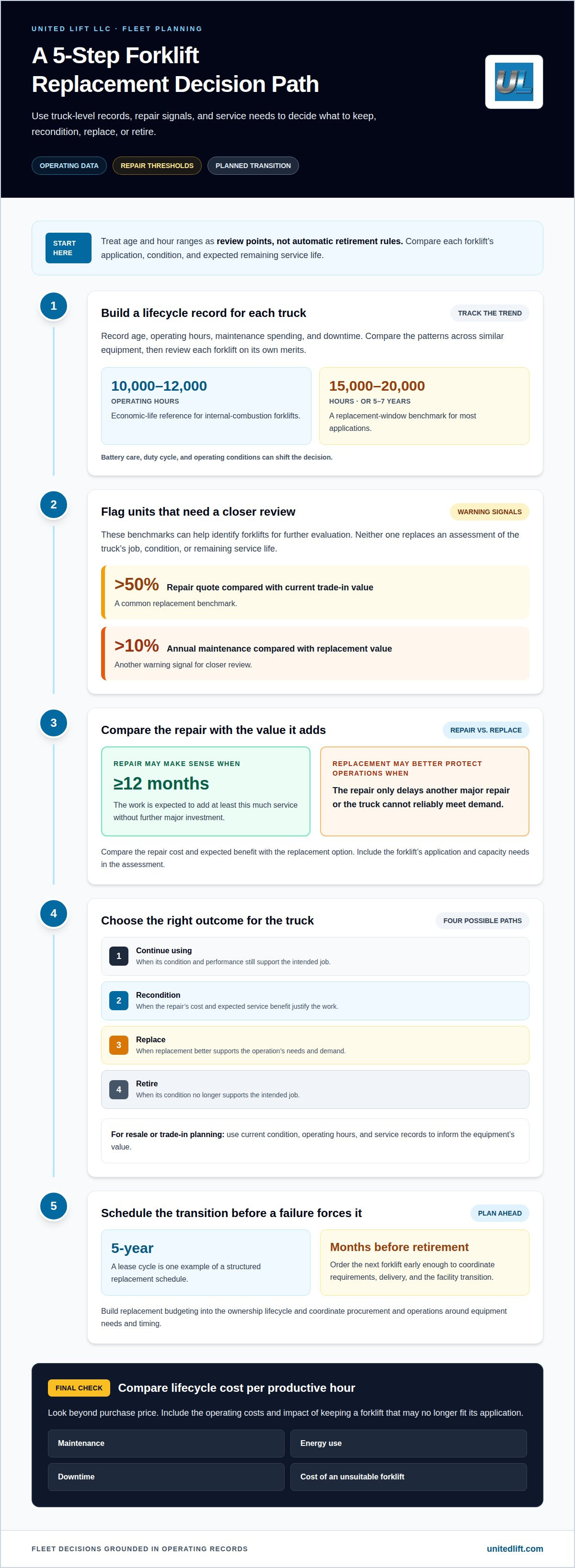
Use operating hours as a stronger planning signal than calendar age alone. Internal-combustion forklifts often reach economic life around 10,000 to 12,000 operating hours, while their total lifespan can vary. For most applications, a replacement window of 15,000 to 20,000 hours or five to seven years offers a planning benchmark. Treat these ranges as review points, not automatic retirement rules. Battery care, duty cycle, and operating conditions can shift the decision.
Build a lifecycle record for every truck, including age, operating hours, maintenance spending, and downtime. Compare these trends across similar equipment. A forklift with low hours and manageable repair costs may remain productive beyond a calendar-age trigger, while a heavily used unit with recurring faults can become an economic concern sooner. Review the fleet as a whole and each truck individually, so one aging forklift doesn’t dictate capital decisions for every operation.
Finance and operations should work from the same cost picture. Operations can report productive hours, repair frequency, and material-handling delays. Finance can compare those records with ownership or lease terms and projected replacement needs. A fleet review can establish cost per operating hour. Track the trend over time: rising repair spending combined with declining availability may hurt productivity, even when the forklift still meets basic capacity needs.
Include operator performance and safety conditions in the review. Impact records, access controls, and equipment-use information can reveal repeated impacts or patterns linked to damage. If impacts are excessive, schedule operator training and examine the work conditions contributing to them. Training can help reduce accidents, product and building damage, and potential injuries. Check these findings against inspection and maintenance records before deciding whether to repair or replace. This brings people, equipment, and operational demand into one decision, rather than treating replacement as a finance-only challenge.
3. Replacement, reconditioning, resale, or disposal planning
Set a decision path for each forklift: continue using it, recondition it, replace it, or retire it. A repair quote above 50% of current trade-in value is a common replacement benchmark, while annual maintenance exceeding 10% of replacement value is another warning signal. These thresholds help fleet management flag units for closer review. They aren’t a substitute for checking the truck’s application, condition, and expected remaining service life.
For a borderline repair, compare the repair’s cost and expected benefit with a replacement. Repair may make sense if it adds at least 12 months of service without further major investment. If the work only delays another major repair, replacement may better protect the operation’s ability to meet demand. For resale or trade-in planning, use current condition, operating hours, and service records to inform the equipment’s value. Retire a truck when its condition no longer supports its intended job.
Build replacement budgeting into the ownership lifecycle instead of waiting for a failure. A five-year lease cycle is one example of a structured schedule. With a planned replacement model, order the next forklift months before retiring the current one. This gives procurement and operations time to coordinate equipment requirements, delivery timing, and the transition at each facility. Forecasting the transition can also help supply chain teams plan for changing application needs.
Assess lifecycle cost per productive hour, not purchase price alone. Include maintenance, energy use, downtime, and the cost of keeping an unsuitable forklift in service. After deployment, compare actual performance with your forecasts. If the replacement’s application, productive hours, or wait times differ from the plan, use those findings to adjust future budgets. A proactive review connects fleet records with capital planning and helps phase out dated equipment without replacing every truck at once.
4. Forklift economic life and replacement timing
A forklift’s economic life ends when keeping it productive costs more than its value to the operation, not simply when it reaches a certain age. For most applications, a replacement window of 15,000 to 20,000 operating hours is a useful planning reference. Power source and maintenance history matter: electric forklifts typically reach a replacement point after 8,000 to 12,000 hours, while internal-combustion models typically last 10,000 to 15,000 hours. Battery care can extend an electric forklift’s economic life.
Look for the point when repair spending starts eroding productive time. Non-preventive maintenance above $4.00 per operating hour over a rolling 12-month period may warrant replacement. Forklifts older than seven years may also have maintenance costs up to twice those of newer units. Use these indicators with downtime, service history, and actual work output. One high repair bill alone doesn’t show whether a truck has reached the end of its economic life.
Warehouse changes can alter the replacement decision. New racking, narrower aisles, higher lift requirements, or a different inventory mix may make an existing forklift a poor fit before it reaches an hours-based threshold. Review its capacity and visibility in the current application. If demand has shifted, fleet records may reveal an opportunity to reassign equipment instead of adding a unit or relying on rental coverage during a peak.
Turn those signals into a replacement plan. Forecast operating hours and maintenance spending for each truck, then compare the expected cost of keeping it with the cost of replacing it. For example, a high-use forklift approaching the replacement window for its application deserves earlier budget attention than a lightly used unit with stable performance. Schedule the transition before repeated downtime disrupts warehouse flow. This gives operations and finance a clear basis for timing capital spending and keeping the right equipment for each job.
United Lift: Forklifts
United Lift LLC offers new and used forklifts for operations planning a replacement or adding equipment to meet changing application needs. First define the job: consider load requirements, lift height, aisle width, operating environment, and expected use. These details help narrow down the forklift type that fits the work.
If your operation also needs equipment for elevated work or moving materials across uneven ground, United Lift LLC offers boom lifts, scissor lifts, and telehandlers. Match the equipment category to the task rather than replacing a forklift with a unit that doesn’t suit the application. A clear picture of the work and replacement timing helps focus the decision.
Contact United Lift LLC to discuss equipment for your fleet.
Put your next fleet decision in motion
A replacement plan works best as an active operating tool, not a document that sits untouched. Set a regular review date, assign responsibility for updating fleet records, and connect upcoming equipment decisions to workload changes. This gives operations and finance a shared basis for acting before an aging or mismatched truck disrupts planned work.
Use your next review to identify the job each incoming unit must handle. Changes to facility layout, inventory movement, or material-handling demands may call for a different equipment category, not simply a like-for-like replacement. A practical forklift fleet replacement strategy connects application needs to purchasing decisions and future capacity.
United Lift LLC offers forklifts, boom lifts, and telehandlers for different equipment needs across your operation. Share the work your fleet needs to handle with United Lift LLC to discuss the right next step.
Contact United Lift LLC about your fleet and keep your replacement plan moving forward.
Frequently Asked Questions
Should I buy or lease forklifts for my fleet?
Buy a forklift when sustained use and control over the asset fit your operating plan. Consider leasing when a scheduled replacement cycle better matches your needs. For example, a truck assigned to daily core work may justify ownership, while equipment for a changing project may call for a different commitment. Before deciding, compare each option’s terms, expected use, maintenance responsibilities, and effect on cash flow.
How do maintenance costs compare to replacement value and downtime risk?
Compare maintenance spending with both replacement value and the operational cost of lost productive time. A repair quote exceeding 50% of current trade-in value is a common replacement benchmark; annual maintenance above 10% of replacement value is another signal to assess. Also account for missed production, delayed loading, overtime, and emergency rentals. A repair that looks manageable alone may cost more once disruption is included.
What is the average lifespan of a forklift before replacement?
There’s no single lifespan that fits every forklift. Internal-combustion units often reach economic life around 10,000 to 12,000 operating hours, while electric models commonly reach a replacement point around 8,000 to 12,000 hours. Actual service life depends on duty cycle, maintenance, operating environment, and, for electric equipment, battery care. Use those hour ranges to trigger a condition and cost review, not as automatic retirement dates.
How to calculate total cost of ownership for forklifts, including energy, maintenance, and downtime
Over the expected ownership or control period, add purchase or lease costs, maintenance, energy use, and downtime costs. Include emergency rentals, overtime, missed production, delayed loading, and extra maintenance labor. Divide the total by productive operating hours to compare forklifts by cost per productive hour.
- Tags: equipment lifecycle, fleet maintenance, fleet planning, forklift fleet management, forklift fleet replacement strategy, forklift leasing, forklift replacement, warehouse equipment
