
How to Use an Equipment Loan Calculator to Estimate Your Costs
Posted by United Lift LLC on
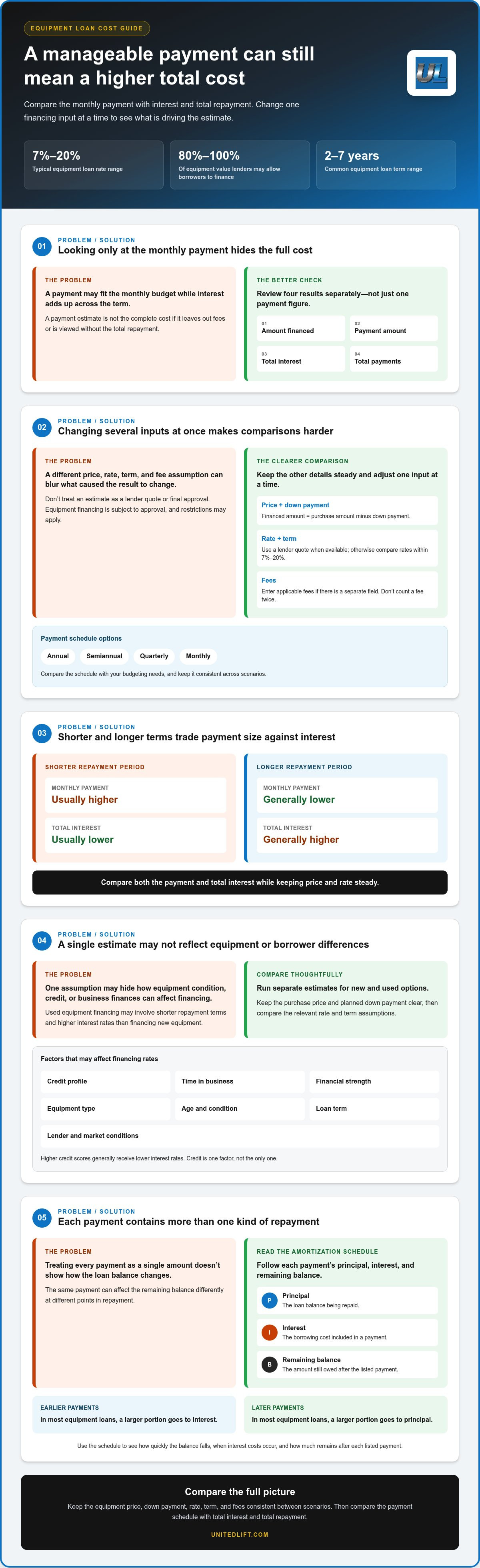
The monthly payment is only part of an equipment loan’s cost. An equipment loan calculator estimates payments, interest, and total repayment using the equipment price, interest rate, and loan term; a down payment can lower the amount financed. Equipment financing rates typically range from 7% to 20%, so changing the rate or term can shift the estimate substantially.
It’s easy to focus on a payment that fits the monthly budget and overlook how much interest adds up over the full term. This guide explains how to enter your figures, compare payment schedules, and understand the results, including the difference between principal and interest. You’ll also see how the equipment price, rate, and repayment length affect monthly payments and total cost, so you can use estimates to plan your purchase and weigh the trade-offs.
Key Takeaways
- Separate the amount financed, monthly payment, interest, and total repayment to see the full cost of a purchase.
- Adjust the equipment price, down payment, interest rate, and loan term to compare how each input changes your estimate.
- Use an amortization schedule to follow how payments shift between principal and interest over time.
- Compare shorter and longer terms by weighing monthly affordability against the total interest paid.
- Treat calculator results as planning estimates, then consider the equipment that best fits your operation.
Calculator results: financed amount, monthly payment, interest, and total cost
Enter the purchase details, then compare the estimated payment with the total repayment. An equipment loan calculator shows how different financing inputs affect each result.
- Enter the equipment price and down payment. The financed amount is the purchase amount minus your down payment. Most equipment lenders allow borrowers to finance 80% to 100% of equipment value. A larger down payment lowers the balance used to calculate payments and total interest.
- Input the annual interest rate and loan term. Equipment loan interest rates typically range from 7% to 20%. Use the rate and repayment period you want to compare, then note how each changes the monthly payment. A longer term generally lowers each payment but increases total interest.
- Add fees if the calculator has a separate field. Fees can affect the overall financing cost, so don’t treat the payment estimate as the complete cost if fees are excluded. Keep the equipment price, down payment, rate, term, and fees consistent when comparing scenarios.
- Select a payment schedule: annual, semiannual, quarterly, or monthly. Compare the schedule with your budgeting needs.
Review the Calculated Loan Costs
Review each result separately: the amount financed, payment amount, total interest, and total payments. Compare the payment schedule with the total cost, and note whether the calculator includes fees. Don’t judge affordability by the monthly figure alone.
Check Financing and Payment Differences
Distinguish prequalification from final approval: equipment financing is subject to approval, and restrictions may apply. Down payment requirements vary, and the amount financed affects both payments and interest. Loan payments repay principal and interest, while lease payments cover equipment use under contract terms; ownership depends on the agreement. In the United States, a business may be able to deduct equipment loan interest and depreciation, depending on its circumstances.
Equipment price, interest rate, and loan term inputs
Enter the equipment price, planned down payment, quoted annual rate, and intended repayment term. Without a lender quote, compare estimates across the typical 7% to 20% equipment loan interest rate range, then assess each term against your budget.
-
Enter the Equipment Price and Loan Term
Start with the equipment’s purchase price, then enter the down payment separately if the equipment loan calculator has a dedicated field. This shows how much you plan to finance. Choose a repayment term from the available options, and keep it consistent when comparing equipment loans. Common terms range from two to seven years, though longer terms are available.
For a used machine, base your estimate on its purchase price and planned down payment. Financing used equipment may involve shorter repayment terms and higher interest rates than financing new equipment. Run separate estimates for new and used options so differences in price and term don’t obscure the effect of each input.
-
Consider Credit Scores and Interest Rates
Enter the annual rate shown in a lender quote when you have one. If you’re comparing possibilities, test rates across the 7% to 20% range rather than relying on a single estimate. Borrowers with higher credit scores generally receive lower interest rates. Your credit profile is one factor, not the only one.
Equipment financing rates can also depend on time in business, financial strength, equipment type, age and condition, loan term, and lender and market conditions. Change one input at a time to see how a rate adjustment affects estimated interest without confusing it with a different term or equipment price.
- Check whether the calculator asks for an annual percentage rate, or APR, and enter the lender’s quoted figure in the matching field. APR and interest rate describe related borrowing costs, but fees can affect APR. If the tool has a separate fee field, enter applicable financing fees there. Don’t count the same fee twice.
When a quote isn’t available, test several rate assumptions within the typical 7% to 20% range. Keep the price, down payment, and term unchanged for each run. Then compare the estimated interest and payments. This gives a clearer view of rate sensitivity than changing several inputs together.
- Compare a shorter term with a longer one while keeping the equipment price and rate steady. A shorter repayment period usually means higher payments but less total interest; a longer period can lower payments while increasing total interest. Choose scenarios that reflect what your business can manage throughout the repayment period.
Separate calculator estimates from qualification decisions. Some equipment lenders commonly require businesses to have at least one to two years in business and annual revenue of at least $100,000. Lenders also weigh credit and financial strength. Use those factors to prepare realistic scenarios, not to treat an estimate as a loan approval.
Amortization schedules
- Read the amortization schedule alongside the payment estimate. It breaks each payment into principal and interest, then shows the remaining loan balance. This reveals how repayment progresses instead of treating each payment as a single amount. Use the schedule to compare when interest costs occur, how quickly the balance falls, and how much remains after each listed payment.
- These figures show why the payment amount alone doesn’t explain how much of each payment reduces the principal. Check both components and the resulting balance before comparing financing options.
- Follow the balance down the schedule, payment by payment. In most equipment loans, early payments allocate a larger portion to interest, while later payments allocate more to principal. The same payment can therefore affect the loan balance differently at different points. Use the schedule to understand this shift, rather than assuming principal and interest split evenly throughout repayment.
- The ending balance shows the projected payoff under those inputs. Compare the balance after each payment with the starting amount, and confirm that the schedule reaches zero at the end. If the figures don’t align, review the rate, payment frequency, and term you entered.
- Use the schedule to compare a change in term or payment frequency while holding other inputs steady. A longer term can lower each payment but increase total interest, so compare both the payment pattern and total cost. Treat the schedule as a planning estimate, not an approval: lender terms, fees, and final approval details can change actual payments. If considering refinancing, compare the revised schedule with the remaining balance and interest under the current loan.
The example amortization schedule shows five payments. Read each row as a snapshot of the loan at that point: the payment amount, the portions allocated to principal and interest, and the balance carried forward. Comparing rows helps you see whether the balance is declining as expected and how the interest portion changes over time. Keep the estimate’s assumptions in view when interpreting the figures.
A schedule is most useful when you connect its figures to the decisions you’re weighing. If a revised estimate changes the payment or repayment pattern, consider how that affects the remaining balance and interest over the loan’s term. Ask the lender to clarify unclear figures, and compare the schedule with the final terms before using it to plan a purchase. This puts the projected payoff in context without mistaking an estimate for a commitment.
Available term choices
Compare repayment periods while holding the equipment price and rate steady. The term affects both payment size and total interest.
- Start with the terms displayed by your payment calculator. Some calculators offer two, three, four, or five years; others allow terms from one to 10 years. These are tool settings, not a promise that every lender offers each option. Use the available choices to build comparable estimates before starting an application.
Equipment loan terms commonly range from two to seven years, though longer terms are available. Equipment financing terms typically start at two years and may extend to 10 years or longer. Read the selected term carefully, since a calculator may present only a subset of possible repayment periods.
- Run estimates at the shortest and longest terms that suit your needs. Keep the principal, interest rate, and payment frequency unchanged to isolate the term’s effect. A shorter term typically means higher payments but less total interest over the loan’s life; a longer term can lower payments but usually increases total interest.
Compare more than the first payment. Review total repayment and interest alongside the periodic payment. A lower monthly figure can ease cash-flow pressure, but the longer schedule may cost more overall. Use the comparison to identify a trade-off your business can manage.
- Choose a realistic repayment period based on the equipment’s expected working life and role in your operations. Don’t select a term solely to produce the smallest payment. Consider how long the machine will support revenue, how quickly its usefulness may change, and whether the repayment schedule suits its purpose.
Equipment loans or leases generally last at least two years. Treat this as a general pattern, not a guarantee of lender approval. Equipment type, age, condition, business finances, and lender conditions can affect the terms available. Keep these factors in mind when comparing estimates.
- Check how each term affects cash flow before settling on an estimate for your application. A longer repayment period spreads principal over more time, which can lower each payment. It also keeps the balance outstanding longer and commonly increases total interest. Compare the payment schedule and total cost together, not in isolation.
If a calculator offers only two-, three-, four-, or five-year options, use those choices first. If it permits a range from one to 10 years, compare additional terms only when they fit your planning needs. Keep each estimate’s inputs consistent so the lender’s term effect stays clear.
- Record the term, estimated payment, and total interest for each scenario. A simple comparison table can show whether a payment fits your budget and reveal the cost of extending repayment. Use the clearest fit as a planning scenario, remembering that the lender’s offer and approval determine the final terms.
Calculator results and limitations
An equipment loan calculator is a planning tool, not a lender’s final offer. Equipment financing is subject to approval, restrictions may apply, and rates may change. Loan risks include repayment costs that strain cash flow, changing rates, and possible prepayment penalties. Paying off a loan early can save future interest, but a lender may charge a penalty.
- Compare the estimate with the intended purchase before deciding. Review the amount financed, payment schedule, and total interest together. A monthly payment can seem manageable even when the total repayment costs more than expected. Use the same price, down payment, rate, and term when comparing scenarios so each result reflects one clear change.
- Review what the calculator includes. Actual payments may differ because of lender terms, fees, and final approval details. If fees have a separate input, include them there; if not, remember that the displayed total may exclude them. Record the inputs, especially the rate and payment frequency, alongside each estimate.
- Revisit the estimate if interest rates or lender terms change. A new rate can affect scheduled payments and total interest, while a different repayment term changes how long the principal remains outstanding. Rerun the estimate with the same equipment price and down payment but updated inputs. Compare the result with your original estimate rather than relying on memory.
- Read the loan agreement before acting on an early payoff estimate. Paying early can reduce future interest, but a lender may charge a prepayment penalty. Compare the potential interest saved with any penalty stated in the agreement. The calculator’s payoff projection doesn’t replace the contract terms or determine whether early repayment saves money overall.
- Protect sensitive business details when moving from an estimate to an application. A calculator can support planning, while an application may request financial information for lender review. Read the site’s privacy policy before submitting personal or business data. Keep estimates separate from approval decisions, and use the final lender terms to plan actual payments.
Ready to connect your financing estimate with an equipment purchase? Explore equipment options as you plan your next step.
United Lift: Forklifts
United Lift LLC offers forklifts for businesses planning a material handling equipment purchase. After comparing loan terms and estimated payments, match the equipment to the work it needs to do. Consider whether a forklift, boom lift, telehandler, or scissor lift best suits your operation.
Bring your budget estimate and equipment requirements into the decision. The right category depends on the tasks, work environment, and lifting needs involved. If a forklift is the right fit, compare available options with your financing plan. A clear estimate helps you compare purchase scenarios, while the equipment choice keeps the calculation tied to a practical need.
Contact United Lift LLC to discuss equipment options for your operation.
Turn Your Estimate Into a Practical Equipment Plan
Use your financing estimate as a decision tool, not the decision itself. Before committing, consider how the equipment will support daily work, fit your operation, and remain useful as business needs change. An equipment loan calculator helps organize the financial side; the next step is matching the estimate to equipment that serves a clear purpose.
United Lift offers forklifts, boom lifts, and telehandlers for different material handling and access needs. Compare the equipment category with the work ahead, then consider how the purchase fits your broader operating plans. A sound equipment choice connects financing to practical use rather than focusing only on a payment figure.
Ready to discuss equipment loans and the equipment you’re considering? Contact United Lift about equipment loans. Take the next step with a clear estimate and a plan built around your operation.
Frequently Asked Questions
How does an equipment loan calculator estimate monthly payments?
It uses the amount financed, interest rate, repayment term, and payment frequency to estimate each payment. Enter the equipment’s purchase amount, subtract any down payment, and use the annual rate and term from your planning scenario. If comparing equipment types, calculate each purchase separately. This shows how different prices affect payments without blending separate financing needs.
What are current equipment loan interest rates in the United States?
Equipment loan interest rates typically range from 7% to 20%. Your estimate depends on factors such as credit profile, time in business, financial strength, equipment type and condition, loan term, and lender and market conditions. Try more than one rate within that range to understand how sensitive your projected payments are. Use a lender’s quoted rate when you have one, rather than assuming every borrower receives the same rate.
What are typical equipment loan terms and down payment requirements?
Equipment loan terms commonly range from two to seven years, though longer terms are available. Most equipment lenders allow borrowers to finance 80% to 100% of the equipment’s value, so the down payment depends partly on the amount financed. Compare the cash needed upfront with the resulting payment and repayment schedule. Lenders may also consider the equipment and the business’s financial profile when setting terms.
What fees and taxes should an equipment loan calculator include?
Include lender fees when the calculator has a fee field and you know the amounts from the financing terms. Treat sales or other purchase taxes separately unless the calculator clearly includes them in the amount financed. Don’t enter the same charge twice. Tax treatment for loan interest or equipment depreciation is a separate business tax question, depends on the business’s circumstances, and is not a calculator input.
How do credit score and business revenue affect equipment loan rates and approval?
Higher credit scores generally correspond with lower interest rates, according to CurrencyFinance. Lenders may also weigh time in business, revenue, financial strength, and the equipment being financed. Some commonly require at least one to two years in business and annual business revenue of at least $100,000. Use these criteria to prepare realistic financing scenarios, while recognizing that lenders assess the full application rather than one factor alone.
How do I calculate the total cost and interest paid on an equipment loan?
Multiply the scheduled payment by the number of payments to estimate total payments, then subtract the principal borrowed to estimate total interest. Keep fees separate if they aren’t included in the payment calculation. For a useful comparison, calculate each term using the same principal and rate. Then compare total interest and the payment schedule, not just the amount due each month.
- Tags: amortization schedule, business budgeting, business loans, commercial lending, equipment financing, equipment loan calculator, interest rates, loan calculator
